¶ IFR Flight Guide - Australia
G'day, and thanks for choosing to fly in Australia! We hope you enjoy the picturesque coastlines and vast outback we have to offer. This guide is intended to help set you up for success in flying IFR across our region, covering all aspects of flight from phraseology to planning.
¶ Flight Planning
Flight Planning in Australia is fairly standard. Like other countries we use the standard ICAO format, semi-circular rules for cruising, and airways. If you need help filing flight plans, we strongly recommend SimBrief to give you valid routes up to date with the latest AIRAC data. During events, keep an eye out for standard published routes to keep our Centre controllers happy!
Don't put (Australian) SIDs or STARs in your flight plan, the relevant controller will assign this for you.
¶ Callsigns
- Australian registrations on domestic flights can be abbreviated to the last 3 letters, eg VH-ABC becomes ABC
- Numbers will be paired, working backwards, eg QFA123 spoken as 'Qantas One Twenty Three'
- Foreign registrations can be abbreviated to the first 1, and last 2 letters, only after initiated by ATC.
¶ Briefing
As always, briefing is a critical part of flight! You can find official aerodrome charts in the Australian AIP DAP (Departure & Approach Procedure). As for weather, our major airport's publish METARs & TAFs. METARs are published on the hour & half hour. NOTAMs relevant to IVAO Operations will be visable on Webeye, and likewise a live map of our Danger & Restricted Areas is available on Webeye.
You may see 'RFxx.x/xxx.x' at the end of our METARs. This is a measurement of rainfall in mm at the airfield, the first set of numbers referring to the past 10 minutes, and the last set of numbers referring to since 9am local time. Eg 'RF00.0/013.3' would mean no rainfall in the past 10 minutes, and 13.3mm since 9am local time.
¶ Clearance
Some countries want a lot of information before clearance, we're the opposite. Just tell us your callsign & where you're requesting clearance to, and we will come back to you with the IFR clearance. We don't need to know your stand number, aircraft type, or QNH at this stage.
"Perth Delivery g'day VOZ123 IFR to Adelaide request clearance"
You can expect to receive the following components in your clearance
- Clearance limit (usually destination)
- Flight planned route
- Runway (if more than one on ATIS)
- SID
- SID transition (if applicable)
- Initial climb
- Squawk
- Departure frequency
You must read this back in full.
ATC: QFA987 Sydney Delivery g'day cleared to Melbourne via WOL (Wollongong) flight plan route, runway 34R. MARUB7 departure, WOL transition. Climb via the SID to 5,000. Squawk 1234. Departures on 129.7.
In your readback, we'll then need your bay number.
PILOT: Cleared to Melbourne via WOL (Wollongong) flight plan route, runway 34R. MARUB7 departure, WOL transition. Climb via the SID to 5,000. Squawk 1234. Departures on 129.7. Bay Domestic 13, QFA987.
¶ PDC
Pre-Departure Clearance is available in Australia. Unlike a lot of other countries, we do require you to readback elements of the PDC. You must readback the SID, squawk, and provide your bay number.
PILOT: JST357 PDC readback
ATC: JST357 go ahead
PILOT: MARUB7 departure, squawk 4372, bay Domestic 35.
ATC: JST357
¶ Pushback
When giving a pushback instruction, controllers in Australia will give a 'tail' instruction, rather than a facing instruction.
ATC: AAA159 pushback approved tail north
Engine start is generally not required in Australia. Exceptions may apply, for example in some cases for departures to aerodromes within the same TMA. This will be stated in the AIP.
¶ Taxi
We issue taxi instruction in order, starting with the taxiways, then the clearance limit, then the runway (if applicable). There may also be a cross runway instruction thrown in there if needed.
QFA987 taxi via C, cross runway 07, B10, T, to holding point T6, runway 34R.
Australian registered aircraft can switch from Ground to Tower without an explicit instruction when reaching the holding point. Foreign registered aircraft will always be handed off from Ground to Tower.
¶ Takeoff
When you're fully ready, report ready for departure to our Tower controller. They will then come back to you with an instruction.
If you've been assigned a radar SID, you can also expect to receive an assigned heading at this stage. This is a mandatory readback.
ATC: QLK187 assigned left heading 280, winds calm, runway 31 cleared for takeoff.
In addition, you may sometimes receive the instruction 'contact departures when airborne'. In this case, your work with Tower is now done, and you can switch to the departure frequency once you leave the ground. If this instruction isn't given, you must wait for instruction to contact departures.
¶ Departure
When you check in with Departure, report your level passing (to the nearest 100ft). This is so our controller can verify your radar tag matches reality, and 'identify' you. It's also important to remember to do this when the departure controller is controlling Tower top down.
As the Departure controller issues climb instructions, they will usually say 'climb via the SID'. This means it's your responsibility to ensure you remain within the confines of the SID procedure.
¶ Centre
It's time to relax a bit, you've made it to Centre and your workload is decreasing. Make sure to keep listening out for any instructions.
When the time comes, you will be issued your STAR clearance.
ATC: QJE8245 STAR clearance available
PILOT: Ready to copy, QJE8245
ATC: QJE8245 cleared BOREE3A arrival, runway 34R
PILOT: BOREE3A arrival, runway 34R, QJE8245
This will often be accompanied by a descent instruction.
¶ Approach
Once you approach the TMA, Centre will hand you across to Approach who will follow the arrival phase of your flight until you are established on the approach. Similar to how Departure will have instructed you to 'climb via the SID', Approach will usually say 'descend via the STAR'. Again, it's your responsibility to ensure you remain within the confines of the STAR procedure.
You may receive radar vectors if required, in which case the controller is responsible for issuing you track miles to run, to help you plan descent.
You will be advised of your expected approach type on first contact with Approach. Often this will be the visual approach. If you want another type of approach you must let the controller know.
Flying into Sydney? We highly suggest you brief yourself on the Independent Visual Approach procedure first!
¶ Landing
When you first check in with Tower, they may just acknowledge your callsign.
ABC: Melbourne Tower, ABC established ILS-Z runway 16 approach
ATC: ABC Melbourne Tower.
In this case, just continue your approach, the controller willl recontact you when they're ready to issue your landing clearance.
Similar to Australian registered aircraft reaching the holding point for departure, Australian registered aircraft do not need explicit instruction to change from Tower to Ground when vacating the runway, and can do this by themselves. You must stay on the Tower frequency until you are clear of the runway. Foreign registered aircraft require a handoff.
¶ Taxi to Bay
You will be issued taxi instructions to the bay in the same manner as on departure. This should be your last contact with ATC. If we're quiet, feel free to say good bye when you get on stand!
¶ Misc
¶ Procedural Tower
Some of our Tower units also provide a procedural approach service within their TMA. This applies to the following Airports:
| Civil | Military |
|---|---|
| Alice Springs | Curtin |
| Karratha | Scherger |
| Broome | Woomera |
| Hamilton Isl. | |
| Sunshine Coast | |
| Coffs Harbour | |
| Tamworth | |
| Albury |
Procedural Tower's are responsible for their TMA, so you will need clearance from Tower to enter. For this reason, it's important you give the controller plenty of notice and make contact before you enter the TMA. The TMAs are accurately shown on Webeye when the controller is online.
When dealing with procedural tower, it's incredibly important that you follow instructions, and make reports as & when required. Procedural controllers don't rely on radar to see your position & level, they rely on your reports. You won't receive headings from a procedural controller, but rather clearances to waypoints, or descent via the published STARs. It may seem like the controller is being overcautious, this is normal in a procedural environment.
¶ Oceanic
If you're flying internationally, there's a pretty good chance you'll end up speaking to our 'Brisbane Radio' oceanic controllers! Oceanic controllers don't use radar. You may be used to flying in North Atlantic oceanic airspace (Shanwick/Gander/New York), but it's a bit different to that down here. In the North Atlantic, Oceanic controllers use space-based ADS-B, a system similar to secondary radar, to get a visual picture. In Australia, we're still relying on old fashioned position reports!
In real life HF radio is noisy and can be challenging to hear through. For this reason, standardised phraseology is essential. On IVAO, HF radio is not yet simulated, however we still use standardised phraseology.
¶ Phraseology
In your initial call, you need to state the station callsign twice, then your aircraft callsign, followed by the frequency you're calling on.
PILOT: Brisbane Radio, Brisbane Radio, QFA9, 12540.
After this, the controller will acknowledge your call stating your callsign.
ATC: QFA9, Brisbane Radio.
You can then go ahead and give your flight level, next estimate, and SELCAL code.
PILOT: QFA9 OPEGA 0920, FL360, estimate 2427 South 1103 East at 0944. SELCAL LQ-AP.
The controller will then issue you a primary & secondary guard, these are two frequencies on which to contact the controller, the primary being voice & text, and secondary being text only. They will then instruct you to standby for SELCAL check.
ATC: QFA9 roger Brisbane accepts primary guard 12540, secondary 1201, standby for SELCAL check.
Wait for the SELCAL to come through (this will be an audible notification through your Altitude client), and then readback the frequencies and confirm SELCAL received.
PILOT: Primary 12540, secondary 1202, SELCAL check ok, QFA9.
That was a lot, but you're now checked in with Brisbane Radio. So you're reaching your next waypoint, what now?
PILOT: Brisbane Radio, Brisbane Radio, QFA9 position on 12540
ATC: QFA9 Brisbane Radio
PILOT: QFA9 2427 South 1103 East at 0943, FL360 estimate 2007 South 1063 East at 1010.
ATC: QFA9 Brisbane
¶ SELCAL
SELCAL stands for 'selective calling', and is a system used in real life to allow pilots to maintain 'SELCAL watch', and turn down the noisy HF radio frequency. This is simulated on IVAO. Simply include 'SEL/xxxx' on your flightplan in field 18.
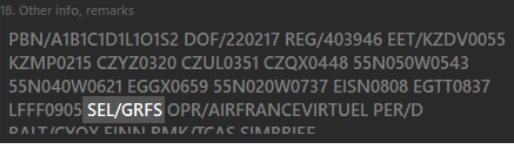
Not all aircraft are SELCAL equipped, in which case you must inform the controller 'negative SELCAL', and will be required to maintain radio watch.